Although it took a little longer than we anticipated, “Turn Your House Into a Rental House Instead of Selling It!” has finally popped out of the incubator and is available as a paperback book.
In a nutshell, what is this book about?
With my charming wife and business partner, Angy, as co-author, we have created a guide on how to find properties, live in them, and then turn them into a rental house, instead of selling them.
According to the “American Association of Realtors,” the average American purchases seven houses during their lifetime. Angy and I believe that those seven houses should be converted into rental houses and held for the rest of our lives. They are valuable assets that will generate monthly income for the hard years to come, and provide further assurance of long-term economic family security. Like the old folktale says: “Don’t kill the goose that lays the golden eggs.”
How does this book help the average Joe?
We show the average Joe where to find the best properties, how to pay for your houses, property inspection, the nitty-gritty steps on how to prepare your new rental house for tenants, how to attract and screen tenants, managing tenants, and complying with EPA regulations. The appendix includes samples of leases, property inspection sheets, tenant selection rating sheets, and many other valuable forms to get you started in your rental house business.
What do millionaires do that most people don’t do?
Go into politics?
Buy their own Starbucks?
Become a bearded recluse?
Well, those are some of the things they do, but according to Thomas Stanley, in The Millionaire Next Door, most American millionaires own their own houses, and they own at least one rental property.
Our perspective is, “If it works for millionaires, it ought to work for us too.”
Our hope is that this book will inspire you to buy a rental property and to receive the enormous benefits from that one bold action. Even if you buy just one rental property throughout the course of your entire life, your economic picture will almost immediately get better.
You may wonder, as we did, “Why didn’t we do this a long time ago?”
“Adversity causes some people to break, and other people to break records.” — Anon
The Governator
I think one of the most powerful motivations in my life is when someone tells me that I can’t do something.
In his autobiography, Total Recall, Arnold Schwarzenegger puts it this way:
Sometimes you have to appreciate the very people and circumstances that traumatized you. Today I hail the strictness of my father, and my whole upbringing, and the fact that I didn’t have anything that I wanted in Austria, because those were the very factors that made me hungry.
Every time he hit me. Every time he said my weight training was garbage, that I should do something useful and go out and chop wood. Every time he disapproved of me or embarrassed me, it put fuel on the fire in my belly. It drove me and motivated me.
What strikes me, is that it wasn’t the fact that Arnold was tormented that made him into the over-achieving force of nature that he became (warts and all), it was the the way that he used that ordeal as motivation to reach his goals.
These kids come to me and ask, ‘Hey Arnie, are you God?’. I just laugh and say ‘Nice try, but keep looking.‘
– Arnold Schwarzenegger
Buying fixer-upper houses, living in them, repairing them, and eventually renting them out is a safe way to generate short-term income and long-term economic security.
Even Arnold Schwarzenegger, in his new book Total Recall, cites investing in real estate as a valuable step on his road to financial success.
But, how can you be sure that a house is worth what you are offering to pay for it? Based on experience, we can “eyeball” the property and probably be able to make a pretty accurate estimate of its worth, maybe 75% of the time
That’s probably closer to 95% of the time for Arnold, with that Terminator vision of his.
Get a professional inspection
However, that’s not good enough. We need more information than our educated eyeball can provide in order to:
1.) Avoid any surprise defects. After you buy the property, trying to get reimbursed for those defects will be too late.
2.) Negotiate a lower selling price for the house.
I hire a professional inspector to provide me with a complete written inspection report that can be used to negotiate a lower price on the house if it uncovers anything that is in need of repair.
Looks straight to me. Why do you ask?
When having the physical inspection done, you should be aware of the most common house problems.
Ten Most Frequent House Problems
A survey of U.S. home inspectors resulted in this list of the most frequently encountered problems:
1.) Improper Surface Grading/Drainage
This is responsible for the most common of household maladies: water penetration of the basement or crawl space.
2.) Improper Electrical Wiring
Includes such situations as insufficient electrical service to the house, inadequate overload protection, and amateur, often dangerous, wiring connections.
3.) Roof Damage
Involves roof leakage, caused by old or damaged shingles or improper flashing.
4.) Heating Systems
Problems in this category include broken or malfunctioning operation controls, blocked chimneys, and unsafe discharge of exhaust.
5.) Poor Overall Maintenance
Includes signs such as cracked, peeling, or dirty painted surfaces, crumbling masonry, makeshift wiring or plumbing, and broken fixtures or appliances.
6.) Structural Problems
Many houses, as a result of problems in one or more of the other categories, sustain damage to such structural components as foundation walls, floor joists, rafters, window and door frames.
7.) Plumbing
Problems consist of the existence of old or incompatible piping materials, as well as faulty fixtures and waste lines.
8.) Exteriors
Flaws in a home’s exterior, including windows, doors, and wall surfaces, are responsible for the discomfort of water and air penetration. Inadequate caulking and/or weather-stripping are the most common culprits.
9.) Poor Ventilation
Perhaps due to overly ambitious efforts to save energy, many home owners have “over-sealed” their homes, resulting in excessive interior moisture. This can cause rotting and premature failure of both structural and non-structural elements.
10.) Miscellaneous
Includes primarily interior components, often cosmetic in nature. May include dents in doors and walls from children’s unsupervised indoor karate practice, or possibly from having Bigfoot (or the Governator) as a former resident. (I inserted those last two examples based on some unfortunate personal experiences I have had.)
A specialist in mold removal or riled up Governator?.
A home inspector’s standard practice typically does not include the following, for which a specific license to inspect and identify is required:
Asbestos
Radon Gas
Lead Paint
Toxic Mold
Pest Control
If you suspect the presence of any of these items, you would contract with inspectors in these areas independently.
Update on “Best Real Estate Investing Blog” Contest
The results are in for the Best Real Estate Investing Blog Contest, and while I did not win, I took the loss in stride, with a minimal of gratuitous moping and whining.
I want to express my heartfelt gratitude to all of you who voted for my blog. Thank you for your support!
Congratulations to Susan Lassiter-Lyons at The Investor Insights for winning the blog contest!
Memos and Tenants
A light, tender, sensitive touch is worth a tone of brawn.
However, my wife and I do everything in our power to keep them from ever even consider moving. We want them to stay forever! It’s the best way to keep our business operating smoothly and profitably.
In the rental house business, we use a light touch when communicating with tenants. A phone call is good when you need to quickly get in contact with your tenant, but if it’s not an urgent matter, our preferred means of communication with tenants is by sending them memos by regular mail.
Use the low-key approach
For example, if the tenant is not keeping up the yard work around their rental property, as agreed upon in the rental contract, we will write them a note in a calm and respectful manner identifying the problem. We may make a reference to the section of the contract that requires them to keep up the yard (but only if they are a repeat offender), and describe what needs to be performed to meet the terms of the agreement.
A phone call could easily put them in a defensive position, and turn into a heated conversation, which is the last thing we want. With a memo, the tone stays calm and the point gets made. And, we have a written record of what we have told them that we keep in the tenant’s file folder.
Keeping tenants informed
We keep our tenants informed about activities that we have planned for their property. We will usually call and let them know well ahead of time if we plan to do some preventative maintenance, on the roof, for example. If a plumber cancels an appointment, we’ll call them so they are not waiting around all afternoon for no reason. It’s really just practicing common courtesy.
As an example, here is a memo that I recently sent to two of our best tenants:
MEMO
Date: November 5, 20xxTo: xxxx and xxxxLocation: 2551 N. Banyon Blvd.Re: Yard work
This is just a friendly reminder that the front yard looks like it might need a little maintenance. I noticed that the weeds were starting to take over the yard a little.
If you could tidy it up a bit, I’d appreciate it. If you need a weed wacker just let me know. I’d be happy to loan you one.
I’m very grateful to have you as tenants. You have been really great about taking caring of the property.
If anything comes up where you need any help with repairs or anything else, please don’t hesitate to contact me.
(If you have already done this yard clean up, please disregard this letter.)
What do you do when you need to earn some money quick, and the job market is tight?
When you rely on multiple streams of income, and you don’t have a regular eight to five job, it’s good to have a job that you can turn to that is certain to generate income when you are in a financial tight spot.
For me, one such job is to become a substitute teacher.
We can all think of many reasons not to like about being a substitute teacher, but one overriding reason to like it is that you can generate some quick cash.
The only requirement is that you must have a teaching certification to quality. You don’t have to have actually taught in the past, but you need that certificate in hand. If you already have a degree, there are universities where you can earn a certificate in one year, while studying part-time.
I have been a substitute teacher two times. Once, when I returned from working in Honduras with the Peace Corps, and the second time was when I started again just last month.
5 Reasons to be a Substitute Teacher
1.) Steady money. In the district I work with, substitute teachers are paid between $75 and $125 per day, depending on location of the school and teacher experience.
2.) Short hours. It’s usually 6 to 7 hours.
3.) Interesting people. Teachers and school volunteers turn out to be very interesting people to get to know. Some of them are down right inspiring. I met an effervescent grandfatherly gentleman last week at lunch in the teacher’s lounge who was a minister/substitute teacher. He had worked on the Indian Reservation, and several other remarkable places, as part of his career.
4.) To get a microscopic view of our educational system. I have a better understanding of the strength and weaknesses of the education system. The system is good in that it funnels the energies of many dedicated teachers into schools, but I found many kids attending schools are not prepared to succeed in school, mainly through a variety of issues in their home life.
5.) You get paid no matter how bad the day goes.
3 Reasons not to be a Substitute Teacher
1.) You can be stuck with bad students for the entire day. Sometimes all you can do is grit your teeth, and just try to get through the day.
2.) You have to connect with kids quickly. Not so easy when you don’t know their names or backgrounds, and they see “having a substitute” with synonymous with “having a free day.”
It’s a great feeling when you do connect with kids. Recently, I had one student come up and talk to me what his goals in life were, and one of his goals was to become a teacher. Sometimes students will come up to me after class and tell me that appreciated having me as their substitute teacher, or ask when I’m coming back again. That always helps the old ego.
3.) Some kids won’t like you no matter how good you are. They don’t want to be in school, and they don’t want people telling them what to do, least of all a substitute teacher.
Coping mechanisms to maintain some control of the classroom
Here are some ways that I have discovered to keep the kids pointed the right direction, and to maintain some shred of professional dignity in the process.
1.) Keep kids busy. A good teacher will leave a lesson plan for you that keeps the kids productively busy all day. The bad teachers leave a lesson plan with too few activities for the kids, or in some cases, they leave no lesson plan at all. I always bring my own lesson plan, just in case.
2.) Deal with problems with some sort of consequences, if only to write names on board.
3.) Don’t dwell on bad experiences; start with a clean slate each day. Let criticism roll off you like rain off duck’s back.
4.) If one thing doesn’t work with the kids, try something else. I have certain activities, like games and brain twisters, to fall back on that work in most circumstances. This is easier to do, the more experience that you have.
Of course, there is a humorous side to being a substitute teacher:
Important Notice about Fix em Up Rent em Out:
My blog has been nominated in the Best Real Estate Blogs Contest. If you would like to cast a vote in support of my blog:
Move all of your furniture and personal belongings out of your old house. The absence of these items makes the house look bigger and the home is more inviting if it is not cluttered up with beds, chairs, food supplies, and toys. It also makes it easier to do a thorough job of cleaning the house.
This only applies to the first time you rent out your new rental house. After tenants leave in the future, they will take most of their things with them. Of course, some tenants do not follow the normal procedure, and they may leave in the middle of the night to avoid paying their last rent check.
(Occasions like this make it tempting to slip a magnetized GPS tracking device under the fender of the renter’s car.)
An incident like this happened to me a couple of years ago. Not only did the tenant leave a pile of clothing, bottles and boxes of cleaning supplies, cupboards of food, and a sofa, but also left behind a car that didn’t work. (So much for the GPS idea.)
Renters like this one are the exception. Tenants normally take all their things with them when they leave, making it easy for me to prepare the property for the next tenant, and without much effort, present an appealing yet empty house.
Step 2: Clean Up
Thoroughly clean the house. This includes painting walls (a fresh coat of paint makes the place look and smell good), washing floors, cleaning appliances (especially the oven), shampooing carpets, washing the windows, cleaning the bathrooms and checking the roof.
Step 3: Make Repairs
Take care of all repair work. Leave nothing to chance and make all repairs before tenants move in. Change broken outlets and switches, patch holes, remove stains, replace cracked and broken glass, repair dripping faucets, replace missing shingles, and fix roof leaks.
The old saying that “Left to themselves, things always go from bad to worse,” is especially true with rental houses. It’s tempting to assume that that small leak in the bathtub, or a toilet that flushes most of the time, won’t bother anyone. But trust me, you will get that call to repair the bathtub or toilet at the most inopportune time.
This doesn’t mean that everything in the house has to be new, but everything should be in working order.
It is a rental house after all, and not Buckingham Palace.
For example, bedroom doors do not have to be replaced every time they have a crack or a hole in them. I rehabilitate the door with wood putty, and a fresh coat of paint. The guy in the “Easy Repair of Hollow Core Door” video below uses drywall mud to fill the hole, with equally good results.
Buy used construction materials
Missing or broken light switches, outlets, covers can be replaced inexpensively with quality used ones. I have also purchased reliable doors, cabinets, stove tops, dishwashers, and toilets at stores that recycle construction materials, for pennies on the dollar. The Habitat for Humanity Store is one such place that I frequent for good used materials. There are 825 Habitat Restores in the United States and Canada. You can locate a store near you at www.habitat.org
Buy new or used appliances?
If broken clothes washers or dryers cannot be easily repaired, our policy is to replace them with a quality used one, or with lower end new appliances (like the Kenmore brand from Sears).
Buy bargain appliances before you need them
Craigslist and yard sales are great places to find good used appliances at bargain prices. If I see a nice working appliance for a good price, I will purchase it, even though I don’t have any immediate need for it. I’ll just store it in our shed until I need it.
I bought a like-new furnace at a yard sale for only $40 and installed it into a rental house and it has worked great. For furnaces, there are very few moving parts to worry about, and the wiring is relatively simple. As long as the motor works, you’re home free.
I once literally picked up a clothes dryer from the side of the road that had a “Free Dryer” sign taped to it. I gave it a new home and it has been working
Low maintenance yard (in the southwest)
reliably for over 10 years now. The only repair, about five years ago, was that I had to change the on/off switch on the door.
Step 4: Simplify Landscaping
The front yard of your rental houses must look great. Curb appeal gives the potential tenants a good first impression. Simple and neat landscaping gives the client comfort that the yard is low maintenance and ecologically and economically low in water consumption saving the tenants money on water and saving you time later not having to replace a yard of dead plants.
This yard went too low maintenance!
I personally like to utilize decorative rocks on our rental yards, and plants that don’t require any watering, like Mesquite and Palo Verde trees, which have long roots that tap into the aquifer.
Step 5: Re-key the Locks
One other thing that I like to do before a new tenant moves in is to re-key all the locks. This is cheaper than buying new doorknobs, and it provides security for our tenants. This protects you and your tenants in case a previous tenant has surreptitiously kept an extra copy of a house key.
Eventually, tenants experience that “feeling I get when I look to the west, and my spirit is crying for leaving,” which Led Zeppelin describes, and they move away.
When this happens, you will want to make the transition of the tenant out of the house as smooth as possible. The best way to do this is by telling the tenant what you expect from them. We send a letter that clearly spells out the checkout process. This way there are no misunderstandings, we are all on the same page, wavelength, sheet of music, or stairway to heaven.
Move Out Information Letter to Tenants
Some key things that we mention in our letter are:
1.) How much of their security deposit will be returned.
2.) There will need to be a review of their check in sheet (and attach a copy for them).
3.) What you expect in terms of house cleaning.
4.) Reminders to contact the utility companies to disconnect services in their name.
5.) Reminders to cancel newspaper and other subscriptions, and to provide the Postal Service with a change of address form.
6.) Reminders to contact us when they are ready for the final house inspection.
7.) A note that if keys are not returned, they will be charged.
8.) Any costs that we must pay to repair the house will be taken out of their security deposit, and we will refund the money due them within 10 days.
(The link to my letter may not work on Internet Explorer. It seems to work fine with Google Chrome.)
Why be lenient with the damage deposit?
In general, we are pretty lenient when it comes to charging tenants for little things on the checklist. If they move out, and they have been good tenants, we are going return to them most, if not all of their security (or damage) deposit back, barring some obvious big broken item.
Our perspective is that we made a lot of money from the tenants over the years, and we don’t want them to leave on a sour note just because they thought we might have overcharged them on some ticky-tack repair.
Men of the World Unite!
John and Todd over at FearlessMen.com are staging a mustache and beard growing contest to help raise funds for charity.
I have confidently signed up to participate in the contest, and I have every intention of winning!
I invite you to join me.
The rules are simple:
1. Starting November 1st, start growing you mustache or beard. In the process they will encourage others who see them as they selflessly promote this great cause, to donate to the selected charities.
2.December 1-16 the contestants will have their photos posted at Fearlessmen.com so everyone can vote on said mustaches and beards. On Dec. 17th, the winner will be announced
3. The winner will receive prizes.
For complete details, charge over and read John’s article:
Rather than making a video where you tell people to buy your book, it’s much better to make a video describing how your business operates, and why the type of business in general is a good business to be in. Subtlety always works better than beating people over the head with a sales promotion. Give your viewers something of value and they may return the favor.
For variety, and to broaden my appeal, sometimes I make a video designed simply to inspire people. I tell stories from my life that have inspiring messages, or describe ways that I find inspiration in my own life. In general, the better people know you, the more likely they are to become a customer.
2.) Keep it Short and Entertaining
Logitech Webcam
Many videos on YouTube are long and boring, when they should be quick and fun. I keep my videos short, and I try to include humor in them. I will tell a story that has recently happened to me, or use something that I have recorded in my “humor” notebook, where I record quips or jokes that I have come across.
3.) No Adlibbing
To make sure that I come across as professionally as possible, I write a script before I start recording. The script doesn’t have to be word for word what you plan to say, but just an outline so that you know the key points that you want to make. I always try to include quotes from famous people, and, of course, humor and stories.
Unless you’re Jay Leno, don’t try to adlib your way through a video. It just won’t look as good as you think it does. Think, “nose piercing.”
4.) Break it up into Pieces
Now I do my videos in segments. I will look at my script and decide what I want to say about one key point. I record myself talking about that one point. Then I stop the camera and study the next key point, and so on.
Try to look right into the camera, and speak in a friendly voice as though you were talking to your best friend.
5.) Don’t Overanalyze
Don’t try to overanalyze making videos. As Douglas Adams said,
If you try and take a cat apart to see how it works, the first thing you have on your hands is a non-working cat.
What’s my motivation?
My First Video
For the first video that I made (where I was actually on screen), I was so nervous that I actually wrote out the entire script and read it into the camera. I had my son, Bryan, holding the script next to the camera so that it wouldn’t look like I was reading it.
My son commented, “Surely, people will know that you are just reading.”
I said, “No way. I’ll read it like I talk. And don’t call me Shirley!”
Bryan was right. It did kind of look like I was reading.
Cut!!!
At the end of the video, I was going to stand up and walk away down a peaceful rural path with my dog Blackie (the Wonder Dog), and I got tangled up in the microphone wire. And, the camera pan was jerky as I walked away. The video was unraveling into a Three Stooges experience, but none of that mattered. All that mattered was I somehow got the first video finished and posted.
I did this video before I started using an editing program so, like live TV, we had to get it all on one take.
Here is that first live video, warts and all, entitled “Walk Away From Your Problems and Find Inspiration.”
Two Alternatives to Using a Movie Camera
1. For the Camera Shy
If you really do not wish to appear in a video, you can still produce videos. You can use Easy Screen Capture Video, or ESCV (or any number of similar companies) and just do a voice over of a power point presentation, or use screen shots. It’s amazingly simple to do. You don’t even need a camera.
Here is the first video that I made using the ESCV technology, entitled “Start a Fixer Upper and Rental House Business” (which, looking back seems to run too long).
2. The Economical Way
If you want to do it the cheap and easy way, you can just record your videos using an video camera attached to your computer. I have a Logtech camera that captures sound and video. It clips onto the top of my screen and plugs into a USB port of my computer.
We’re Not Filming “War and Peace”
It’s tempting to think, “I don’t want to show this video to the world until it’s perfect.” Come on, you’re not Quentin Tarantino. We’re not aiming for a masterpiece here. You have to swallow your pride, and just put the video on YouTube, even if it has a few flaws.
People will overlook mistakes, especially if you have good content. My attitude is: my videos are not great, but I’m getting better each time I make another one. The more videos I make the better I get.
In this later video, “The Secret to Success in Less than 2 Minutes.” I employed several of the techniques that I have mentioned. It’s my most popular video with 3,200 views.
Camera and Editing
The camera that I use to record video is the Kodak Zi8. It’s small, easy to use and makes very clear videos. I also recommend that you have a tripod, a remote control, an external microphone, and an 8 GB flash memory card.
For editing, I use Windows Live Movie Maker, which is free if you have Windows. It allows you to cut and paste your video, and add music and titles.
Show People How to Do It!
Most people don’t want to waste time reading how to fix a leaky sink, or repair a car lock, or start a real estate business. They want to see how to do it!
They go to YouTube for answers.
That’s why your videos should be there.
This week’s recommended articles from the blogosphere:
"With the wit of Will Rogers, this book provides simple guidelines for restoring homes, and sanity to our crazy lives." M.D. Matlock, Ph.D., P.E., C.S.E.
"Great information for anyone starting out in the fixer-upper business. The author has served his apprenticeship in the trenches." "Fixer" Jay P. DeCima
"You probably couldn't find a better place to start if you are considering investing in a rental property than Sprouse's witty and concise book. " Joanna Daneman, "Top 10" Amazon Reviewer
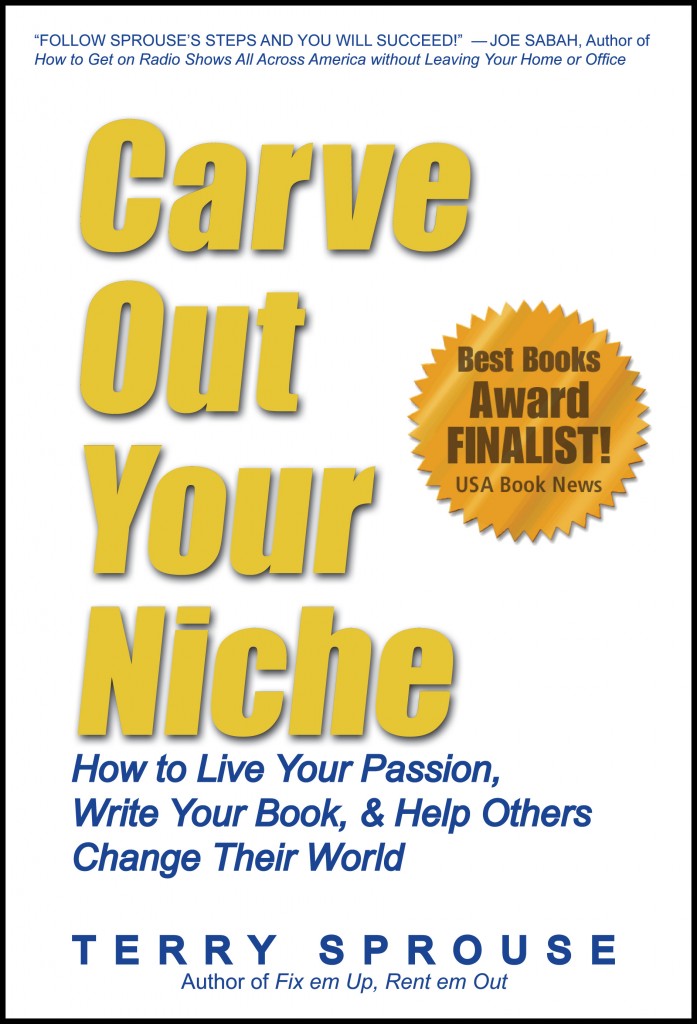
Self-Publish Your Book with “Carve Out Your Niche”
"As a direct result of reading this book, I finished writing my book and published it as well. All of this took place within the past 30 days. " Brian V. Menard, Amazon Reviewer
"Sprouse is one of the most practical authors in this genre I have ever read. 'Carve Out Your Niche' is downright inspiring." Don Blankenship, "Top 50" Amazon Reviewer
"Invaluable for anyone seeking to successfully write, publish, and market their own work" The Midwest Book Review